
Stone notes
How CNC laser templating works, and why it matters for your countertop installation
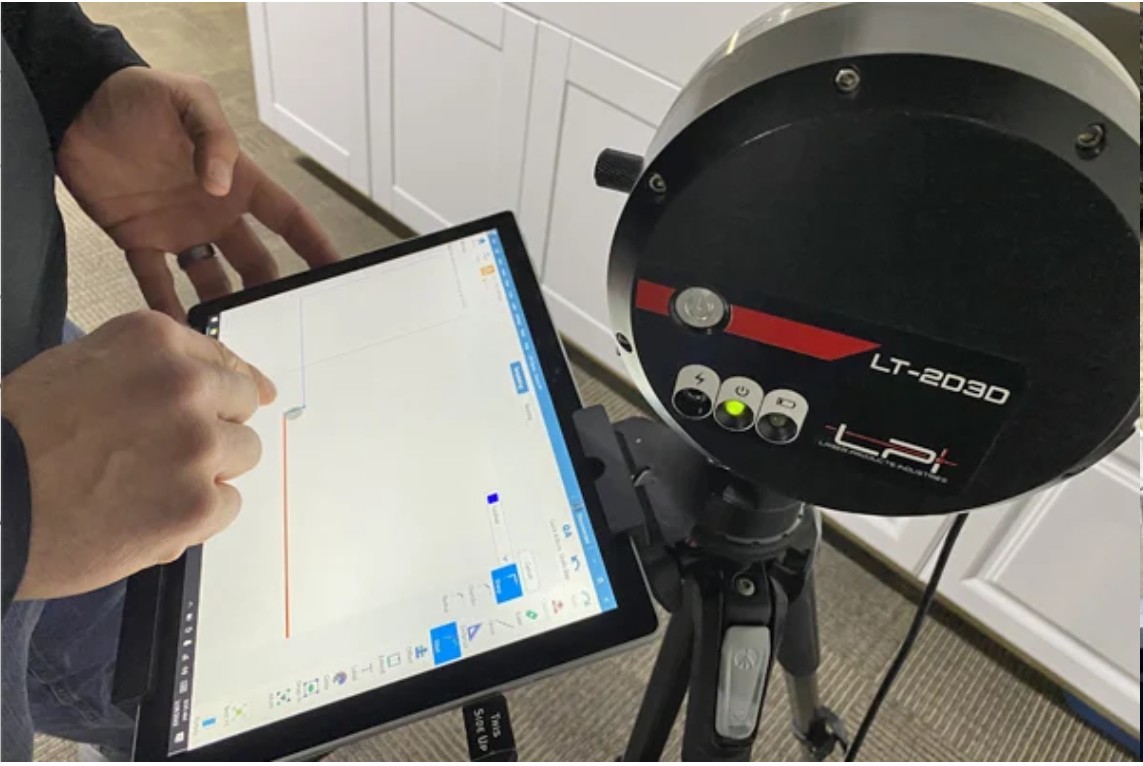
How CNC laser templating works for countertop installation
Templating is the step most homeowners don't think about until something goes wrong. It's the measurement process that tells the fabricator exactly what to cut — where the edges fall, where the cutouts go, how the seams land. Get it right and the stone installs without incident. Get it wrong and install day becomes a problem-solving session, with your kitchen sitting open while someone goes back to the shop to recut a piece.
We use CNC laser templating. Here's what that means and why it matters.
What templating used to mean
The traditional method is a physical template — you cut strips of thin cardboard or lauan (a type of thin plywood), trace the countertop edges, mark the sink and cooktop cutouts, label everything, and carry the template pieces back to the shop. A skilled fabricator can do this accurately. But cardboard expands and contracts, pieces can shift in transport, and the process relies heavily on the person doing it having good technique.
Some shops still template this way. It works, but the margin for error is higher.
What laser templating actually does
A CNC laser templating system uses a laser to plot the exact perimeter of your countertop runs, the locations of sink and cooktop cutouts, window sills if relevant, and any other features that affect the stone. The laser captures coordinates digitally — not as a physical cutout but as a precise set of measurements stored in a file.
That digital file goes directly to the CNC (Computer Numerical Control) equipment in our shop, which cuts the stone. The saw follows the digital measurements exactly. There's no transcription step where a person re-draws the template dimensions onto stone and cuts to a hand-drawn line.
Why this produces better results
Precision. Laser measurements are accurate to within a millimeter or two. That's tighter than a hand-measured cardboard template can reliably achieve, especially across a long countertop run or a complex L-shape. The difference shows up most clearly on seams and cutouts.
Seams fall where they should. On a long run of countertop, there's usually at least one seam. On a laser-templated job, the seam placement is calculated and consistent — not subject to minor variations from manual measurement.
Cutouts fit. The sink or cooktop cutout is one of the most unforgiving parts of the job. If a cutout is off by more than a few millimeters, the sink doesn't sit right. With CNC laser data feeding the saw directly, the cutout is accurate.
Install day stays on schedule. When the template is precise and the cut follows it faithfully, installation is straightforward. We set the stone, make sure everything fits and looks right, seal the joints, and we're done. Surprises on install day — where something has to be recut in the field — are very rare with a laser-templated job.
What happens at the template appointment
After you've chosen your slab and we've confirmed the project details, we schedule a template appointment. One of our team comes to your house. The whole process usually takes 30–60 minutes for a typical kitchen.
We walk the space, verify that cabinets are level and plumb (important for how the stone sits), confirm sink and appliance locations, and run the laser around the countertop perimeter. If there's anything unusual — a wall that's slightly out of square, a cabinet that's not quite where the plan says it should be — we note it before it becomes a cut-stone problem.
After templating, we fabricate. Most jobs take one to two weeks from template to install.
One thing the template appointment isn't
It's not the right time to move things. If your sink location is changing or you're still deciding on the island size, nail those decisions before the template appointment. Moving a cutout after templating means retemplating or accepting imprecision — and we'd rather retemplate than cut something wrong.
If you're not sure whether you're ready to template, call us. We'll tell you what needs to be finalized first.
Ready to move forward?
If you're in the Columbia, Lexington, or Cayce area and you're researching countertop fabricators, we'd be glad to talk through your project. Come by the showroom at 2015 Charleston Hwy in Cayce, or send us a message with your project details — a rough sketch and some measurements is enough to start.
Custom Rocky Tops — Cayce, SC Veteran-owned. 4.9 stars on Google. 25,000+ kitchens installed. [Quote form link]